
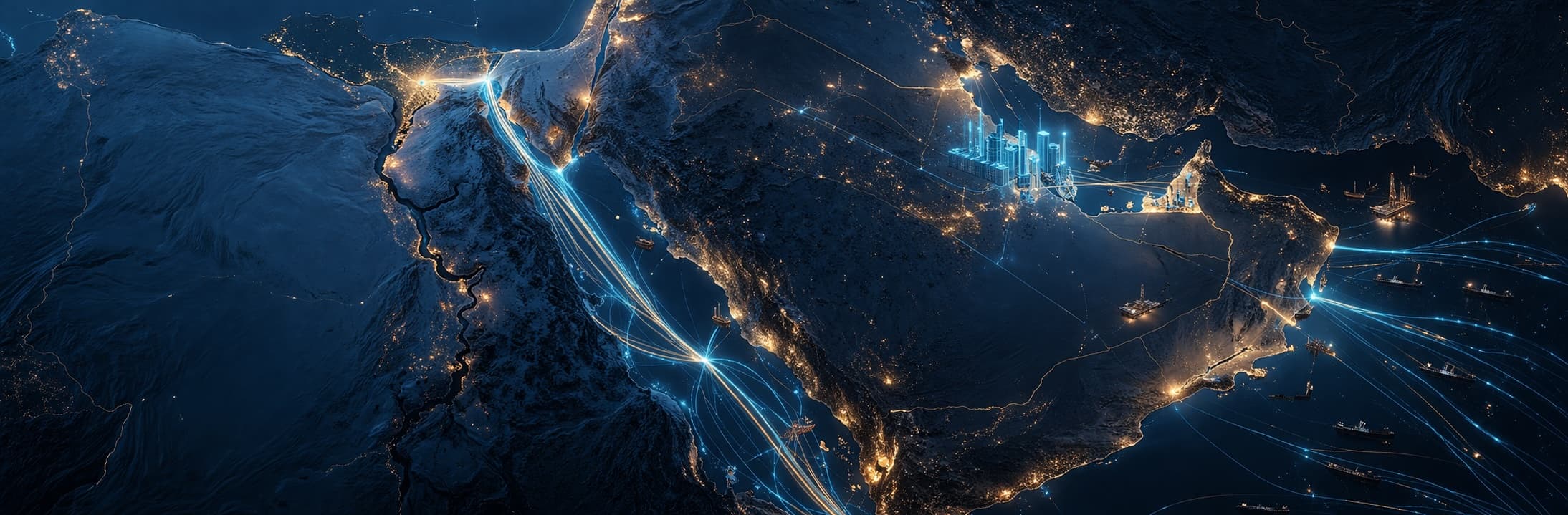
The Iran conflict is being framed, understandably, as "yet another oil shock". But that is now too narrow. The deeper issue is infrastructure geography. The Middle East is no longer only a source of hydrocarbons. It is also a critical layer of the world's digital architecture: a cable corridor between continents, a growing base for hyperscale cloud infrastructure, and an increasingly important destination for AI compute. For investors, the key question is not only what happens to oil. It is whether geopolitical risk is beginning to reprice both commodity infrastructure and digital infrastructure at the same time.12
This is not just another oil shock
The macro damage is real, but it is best understood as a supply shock running through several layers of infrastructure. The World Bank has warned that the conflict could reduce global GDP by roughly 0.3% in a baseline scenario and by more than 1% in a harsher one, while lifting inflation by as much as 0.9 percentage points. The Strait of Hormuz remains central because it carries about one fifth of the world's oil and gas flows. That establishes the scale. The more important point for this note is transmission: Asia is highly exposed because energy, shipping, and digital connectivity all intersect in or around the same geography.2
For Asia, this is not only a fuel-price story. The economic mechanism is straightforward: imported inflation worsens, FX pressure rises, and central banks face harder tradeoffs between supporting growth and containing price shocks. Morgan Stanley estimates Asia's energy burden could rise materially in a higher-oil scenario, and Japanese policymakers have already warned that the conflict could weaken regional conditions through higher import costs and supply disruptions. In other words, the shock hits Asia through prices, currencies, and policy reaction functions at the same time.2
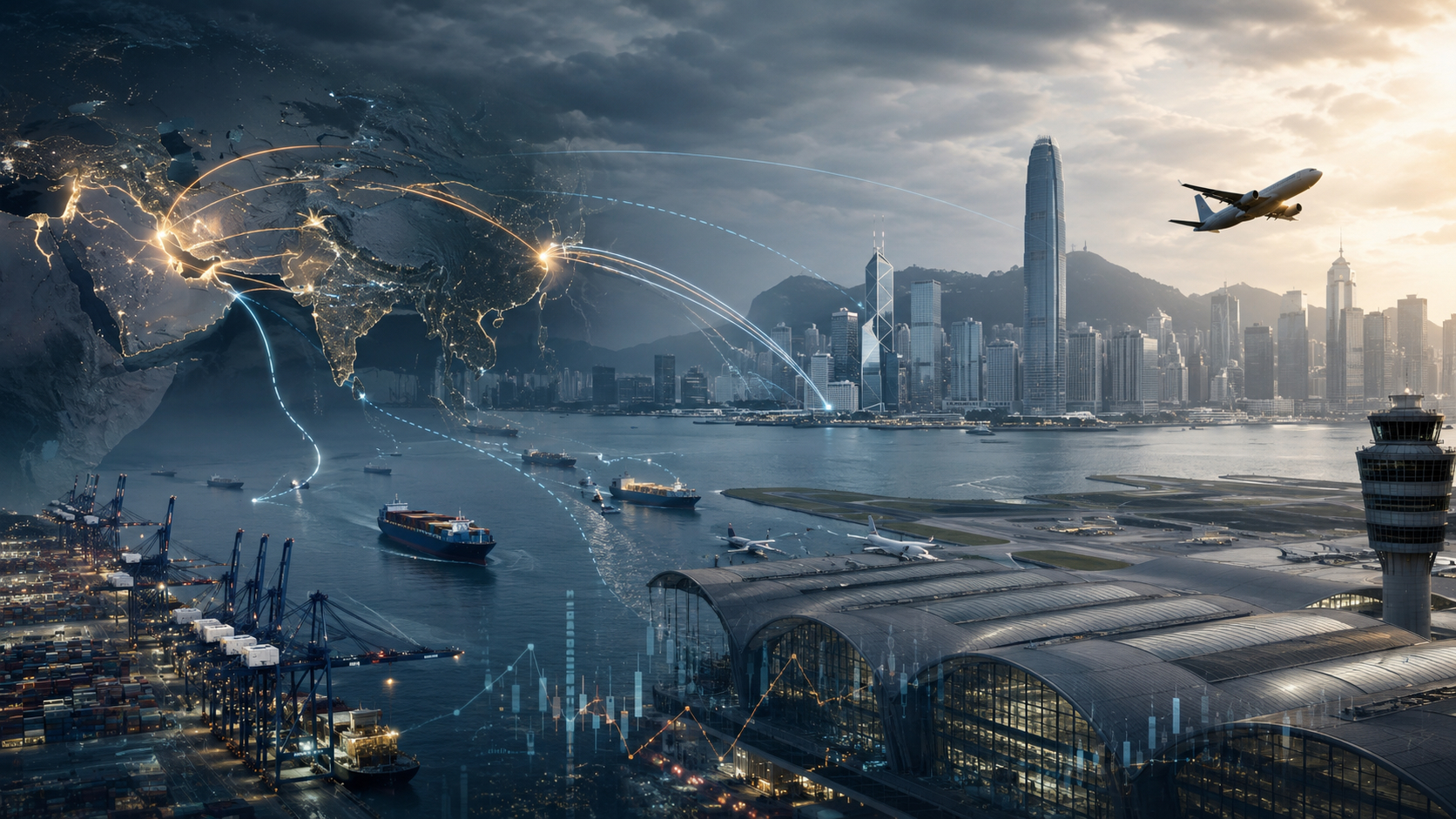
Hong Kong is not insulated. The city is not directly exposed in the same way as a large industrial importer, but it still feels the shock through aviation, transport, and sectors where logistics and utility costs are difficult to pass through cleanly. Cathay Pacific's suspension of some Gulf routes earlier in the conflict was a visible sign that the transmission is not abstract. For Hong Kong investors, this matters less as a local energy story than as a reminder that regional volatility can quickly reach earnings, financing conditions, and cross-border infrastructure allocations.3
Cloud has entered the battlespace
The more distinctive development is that commercial cloud infrastructure now appears directly exposed to kinetic conflict. Reuters reported in March that AWS said facilities in the UAE and Bahrain were damaged by drone strikes, while AWS public health notices described direct strikes in the UAE, nearby physical impacts in Bahrain, and ongoing migration and recovery measures. It is safest to describe this as one of the first documented cases of a major U.S. cloud region being disrupted by military activity.4
Why that matters goes beyond the incident itself. A modern data center is not just a warehouse of servers. It is a stack of dependencies: power delivery, backup systems, cooling, water, fiber backhaul, and regional routing.
A modern data center is not just a warehouse of servers. It is a stack of dependencies: power delivery, backup systems, cooling, water, fiber backhaul, and regional routing.
Goldman Sachs argues that AI-driven data-center growth is now tightly constrained by physical inputs, especially electricity, and expects global power demand from data centers to rise about 50% by 2027 and 165% by 2030 versus 2023 levels. BlackRock makes a parallel point from the capital-markets side: AI investment is front-loaded, revenues arrive later, and the buildout requires heavy spending on compute, data centers, and energy systems. Once cloud is viewed through that lens, physical disruption becomes an economic issue, not just an operational one.1
That economic effect is uneven. Large enterprises and hyperscalers can often spread workloads across multiple regions more easily. SMEs, regulated workloads, and sovereign or public-sector systems may be much more region-sticky. The result is that the same outage can produce very different financial outcomes depending on the customer mix and resilience architecture. The lesson is straightforward: resilience is no longer only an engineering virtue. It is something operators and investors can price.45
Why the Gulf matters for AI
This matters because the Gulf is no longer just transit geography. JLL's latest EMEA data-center report says nine Middle East metros now have about 1 GW of live capacity, with 2.2 GW under construction and 12 GW planned. JLL also says the region's capacity is expected to quadruple over the next five years, with Abu Dhabi and Dubai already accounting for 602 MW and Riyadh alone having 1.4 GW under construction plus 5.2 GW planned. Those are no longer marginal numbers. They indicate that the Gulf is becoming real compute geography.6
The likely demand behind those megawatts is not generic hosting alone. It includes sovereign AI ambition, hyperscaler regional expansion, enterprise cloud demand, and regional inference and digital services. Yet announced capacity is not the same as energized capacity. In conflict-prone settings, planned projects can slip, be resized, or fail to reach operation on schedule. That means the relevant risk premium now extends beyond shipping lanes and pipelines to the cost of building, financing, and insuring megawatts of compute in politically exposed locations.16
Why Asia and Hong Kong cannot treat this as distant
The cable layer is the clearest reason. TeleGeography estimates that over 90% of Europe-Asia capacity is carried by cables in the Red Sea, and its follow-up analysis says about 90% of Europe-Asia communications flow through those cables. CSIS describes Egypt as a compressed digital land bridge between the Red Sea and the Mediterranean, with strategic significance far beyond its coastline. In other words, the Middle East is not only an energy chokepoint. It is one of the world's most concentrated digital chokepoints.7
The practical risk is usually not a Hollywood-style global blackout. Operators have built redundancy into the network, including rerouting around the Cape of Good Hope or across other paths. But the Red Sea remains disproportionately important, so alternatives are more circuitous and come with latency and cost penalties. That is the more realistic infrastructure risk: not total disconnection, but degraded performance, congestion, higher interconnection cost, and a stronger premium on route diversity.8
This also helps explain why hubs such as Singapore become more valuable when Gulf risk rises. The attraction is not only spare capacity. It is political stability, regulatory predictability, dense interconnection, and lower perceived conflict risk. JLL projects APAC data-center capacity will expand from 32 GW to 57 GW by 2030, and Reuters reported that Microsoft is on track to invest $5.5 billion in cloud and AI infrastructure in Singapore through 2029. That does not mean Asia replaces the Gulf. It does mean capital has alternative destinations when the risk-adjusted economics of Gulf deployment deteriorate.9
Hong Kong's role is narrower but still relevant. It is not the obvious substitute for Gulf hyperscale expansion, yet it is more than a passive observer. Equinix describes Hong Kong as a key connectivity hub hosting a leading regional internet exchange and one of the area's most carrier-dense network hubs, while also emphasizing the city's importance to financial institutions and cross-border digital exchange. If resilience begins to earn a larger premium, Hong Kong matters less as a direct winner of hyperscale migration than as a place where that repricing is financed, intermediated, and judged.35
The investment implication
The key investment implication is structural, not just cyclical. This is not mainly a call on the next three months of oil prices. It is a view that infrastructure geography may command a larger discount or premium over a multi-year capex cycle. BlackRock's geopolitical-fragmentation work treats fragmentation as a market-shaping force, while its 2026 outlook argues that AI capex arrives well before revenues. Goldman Sachs, meanwhile, expects a large step-up in data-center power demand. Put differently, the AI buildout is already forcing investors to think more physically. Conflict simply makes that unavoidable.1
In practical terms, that favors APAC digital-infrastructure platforms with stable power, dense interconnection, and lower geopolitical concentration risk over business models overly dependent on exposed corridors. It also strengthens the case for subsea and network-resilience spending, as well as grid and utility assets tied to safer AI growth corridors. MSCI's recent work on physical-risk assessment points in the same direction: resilience is increasingly something investors can price, not just discuss.95
The old view of Middle East conflict was that it threatened barrels.
The new reality is that it threatens both barrels and bandwidth, both fuel flows and cloud zones, both shipping routes and AI infrastructure.
The new reality is that it threatens both barrels and bandwidth, both fuel flows and cloud zones, both shipping routes and AI infrastructure. For Asia, that means the shock is both physical and digital. For Hong Kong, it means this is not just a macro story to observe, but an infrastructure allocation story to price. Allocators who still underweight the physical footprint of AI are likely missing where the next geopolitical risk premium will emerge.15
Endnotes
Footnotes
-
BlackRock Investment Institute, 2026 Investment Outlook. ↩ ↩2 ↩3 ↩4 ↩5
-
Reuters, "World Bank's Banga sees some degree of lower growth, higher inflation due to war". ↩ ↩2 ↩3
-
Reuters, "Hong Kong to see oil shocks and volatility from Middle East war". ↩ ↩2
-
AWS Health Dashboard, "Service health". ↩ ↩2
-
TeleGeography, "What We Know (And Don't) About Multiple Cable Faults in the Red Sea". ↩ ↩2 ↩3 ↩4
-
Reuters, "Amazon's cloud unit says drone strikes damaged UAE, Bahrain facilities". ↩ ↩2
-
TeleGeography, "The Red Sea: A Key Subsea Cable Crossroads Under Siege". ↩
-
CSIS, "The Strategic Future of Subsea Cables: Egypt Case Study". ↩ ↩2