The AI trade is becoming a capital test.
OpenAI and Anthropic's confidential IPO filings make that test more visible. They sit at the edge of a wider financing cycle.
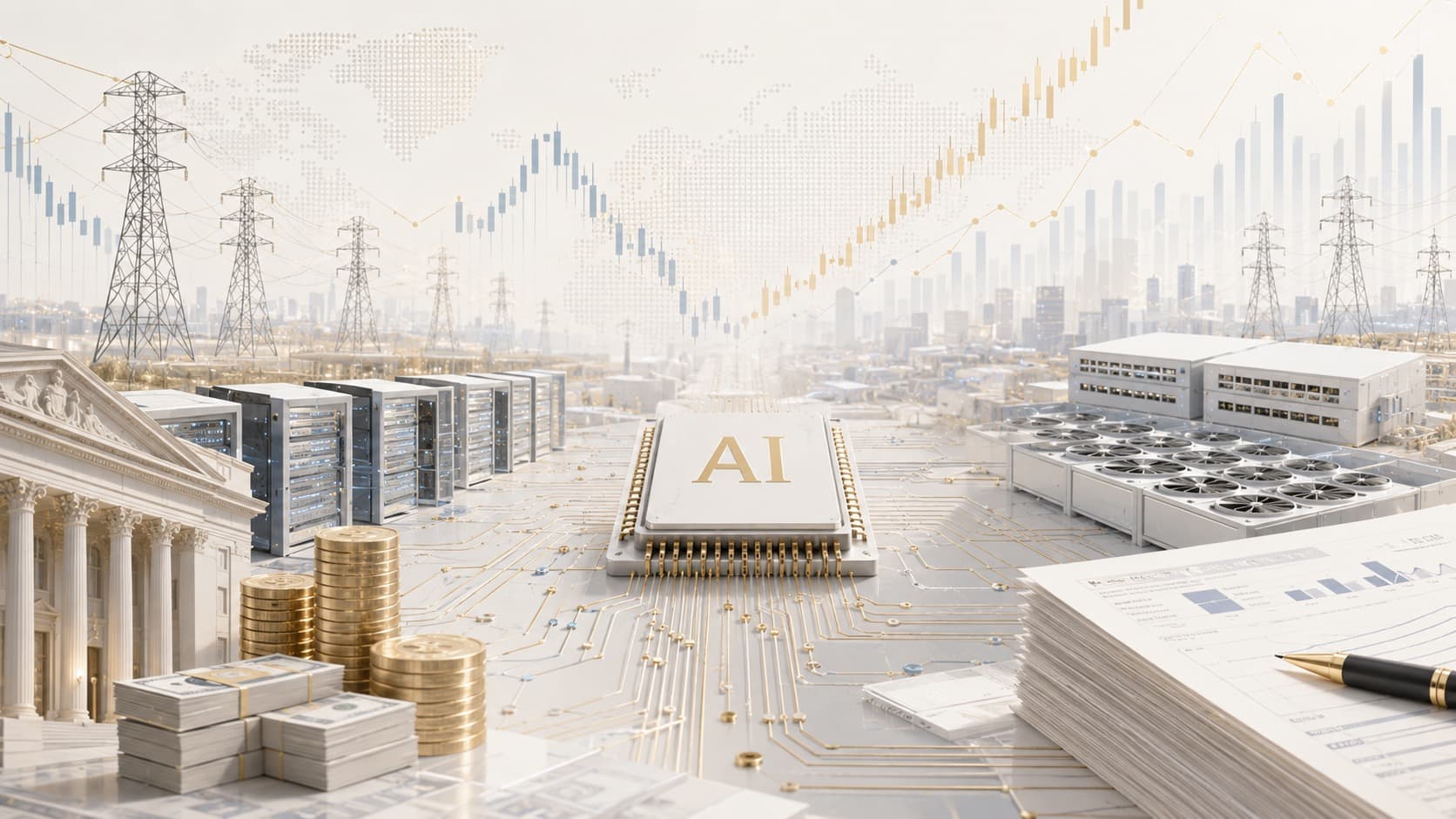
Corporate balance sheets and capital markets are being asked to finance an entire AI ecosystem while investors continue to earn acceptable returns. The AI narrative has widened from productivity and earnings expectations into an infrastructure-financing cycle. The software layer may scale, but the system underneath it depends on chips, data centres, power, networking and cooling. Investors must now ask whether each additional dollar committed to that system can generate durable cash flow.
The scale is already visible beyond private model developers. Reported estimates put combined 2026 spending by Alphabet, Amazon, Microsoft and Meta above US$700 billion, while major technology companies are increasingly supplementing internal cash generation with debt and equity.
From software margins to infrastructure spending
Software investors are used to high margins, low marginal cost and excess cash returning through buybacks. The AI buildout points in a different direction. After years of funding investment largely through internal cash generation, some technology companies are increasingly supplementing their balance sheets with debt and equity to finance AI-related infrastructure.
The business may still be digital, but the investment cycle is physical.
A model query needs compute. Compute needs semiconductors. Data centres need power, land, water, fibre and long lead-time equipment. As usage rises, the required asset base can rise with it.
That is why "asset-light" is becoming harder to read from one company's reported balance sheet. Capital intensity can move onto another company's balance sheet without disappearing from the economics. A model developer may report limited conventional capex while still carrying exposure through cloud pricing, compute commitments, prepayments or strategic dependencies.
The software layer may remain scalable. The system underneath it is capital hungry.
Why valuation becomes a return-on-capital question
If AI revenues require continuous increases in compute and infrastructure spending, valuation depends less on how easily software can scale and more on how efficiently capital is recycled into cash flow. The key variables become capex intensity, utilisation, depreciation, funding cost and the speed at which infrastructure begins to earn.
That shifts the underwriting question. At the company level, incremental returns must exceed the marginal cost of funding. At the market level, investors must absorb rising equity and credit supply without forcing a sharp reset in valuations or financing terms.
That is a different standard from a traditional software-margin story. Public investors may have to apply a hybrid framework, with software economics above the line and infrastructure discipline below it.
The IPO wave is a capital absorption test
The AI capital cycle extends well beyond IPO proceeds. Companies are funding it through retained cash flow, debt, convertibles, equity and strategic investment. Data centres and power infrastructure add another layer of project financing. Public investors must then absorb the resulting supply of AI-linked equity and credit, potentially raising the hurdle for smaller issuers.
Recent IPO filings from leading AI companies make that market test visible. Timelines, valuations and offering sizes can change before any listing is completed.
Large private-market valuation expectations can dominate the IPO discussion, but valuation should not be confused with capital raised. The market absorption question depends on offering size, primary versus secondary mix, initial float and subsequent issuance.
IPO waves should not automatically be read as market-top signals. Past listing cycles often reflected liquidity, risk appetite and a market willing to fund future growth. Still, an IPO wave is never neutral. New supply has to be absorbed. When issuers are tied to the same AI theme already driving index performance, investors are deciding how much capital one theme can command.
The two tests investors should apply
First, returns on capital
The company-level test is whether incremental returns remain above the marginal cost of capital and whether free cash flow grows after the required investment is funded. A capital-intensive AI company must show more than user growth or technical promise. It needs to show that incremental spending can become incremental cash flow.
For the AI trade to absorb heavier issuance without relying on continually expanding multiples, monetisation needs to broaden beyond the first-order beneficiaries. The first-order group includes semiconductors, cloud, networking and data centres. These are the companies closest to the infrastructure buildout.
The application and adoption layer matters for the next stage. It includes software firms, cybersecurity, workflow automation and profitable AI adopters. Broader monetisation would make the cycle more durable. If leadership remains narrow while issuance rises, the cycle becomes more fragile.
Second, access to capital
The market-level test is whether investor demand can absorb new equity and credit supply at valuations that still offer acceptable prospective returns. A company that can fund growth internally is different from one that needs repeated equity, debt or strategic-capital injections. Public-market supply matters more when many companies need capital at the same time.
Higher long yields raise the hurdle rate for long-duration growth companies. They also make equity issuance more demanding, because investors require clearer paths to cash flow. A company can have real demand and strategic importance, while still becoming vulnerable if capital costs rise faster than cash generation. That is what happens when growth becomes an investment cycle.
What the capital test means
The next stage of the AI trade will therefore be less forgiving than the first.
Model capability and user adoption still matter, but they are no longer enough. Investors will have to follow the capital route: who funds the infrastructure, who earns the return, and who carries the risk if funding costs rise.
That does not make AI uninvestable. It makes the underwriting more specific.
The stronger companies will be those that can convert capital intensity into durable free cash flow, without depending on repeated access to generous financing. The weaker ones may still grow, but their economics will remain exposed to the cost and availability of capital.
The question is no longer whether AI can scale. It is whether the capital required to scale it can earn enough.